Find out what a beginner scuba diving course involves.
If you dream of becoming a diver, the beginner course is where it starts. You'll learn scuba diving's fundamental concepts and skills through three parts: online theory, confined-water training and open-water training.
At Master Dive, theory is delivered through PADI eLearning. Study at your own pace on a computer or phone, then arrange your practical training dates with our team.
Finished your online theory? It's time to arrange your in-person training. Your instructor will work through theory exercises and answer your questions. Diving is fun, but learning to do it is taken seriously: there's a theory exam too! The passing score is 75%. If you pass, you'll review any incorrect answers with your instructor. If not, you'll review the material and take the exam again.
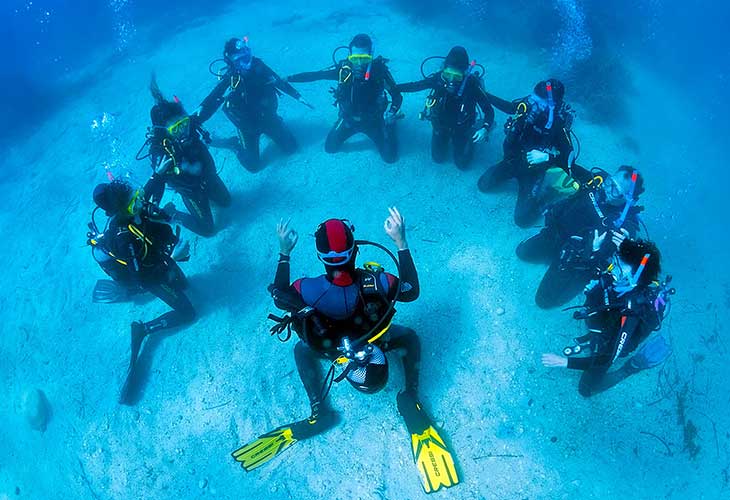
In confined water, your instructor helps you get comfortable underwater. You'll learn to use the equipment—tank, BCD, regulator, wetsuit, weights, snorkel, mask and fins—and develop your basic skills. Schools provide essential equipment. Masks and snorkels are often personal items; some schools rent them, but having your own is ideal. In another article, we explain how to choose the right mask.
In open water, your instructor revisits some confined-water skills to reinforce and refine them. The PADI course includes four ocean training dives, with no more than three per day. You're now in a real diving environment, learning new skills such as boat-diving procedures when your training takes place from a boat.
The minimum age to take a diving course is 10. Students must also complete a medical questionnaire as part of their enrollment paperwork. It helps determine whether a pre-existing condition means you need a medical evaluation before training. See an example medical questionnaire.
Several certification agencies offer diver training programs. This article is based on PADI (Professional Association of Diving Instructors), the agency with the largest presence in the diver training market.
Looking for a way to spend less on your diving course?
Most Brazilian cities are inland, so dive schools need to take students to the coast for ocean training. That adds transportation costs, boat charter and some equipment rental. Popular destinations include Arraial do Cabo, Paraty, Angra dos Reis and Ilha Grande in Rio de Janeiro state; Ilhabela in São Paulo; Bombinhas in Santa Catarina; and Guarapari in Espírito Santo. Arraial do Cabo is especially popular with schools from São Paulo and Minas Gerais. With many local dive operators, competition helps keep prices lower.